
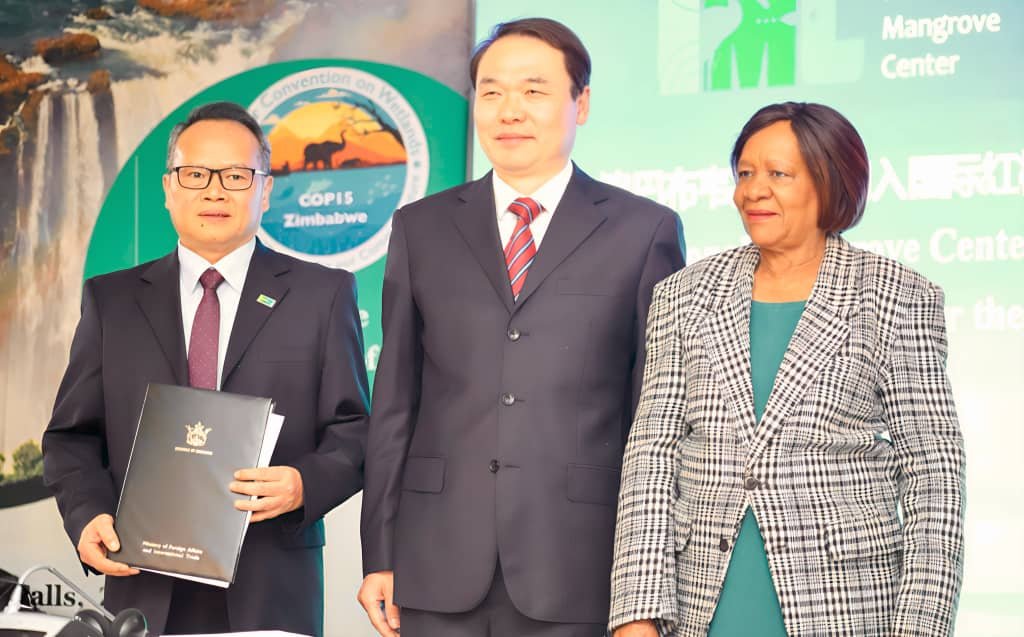
Zimbabwe and China have taken a major step in strengthening global environmental collaboration by signing a Memorandum of Understanding (MoU) focused on wetland, forestry, and grassland management. The agreement was officially signed on Friday at the 15th Conference of the Parties to the Ramsar Convention on Wetlands (COP15), currently underway in Victoria Falls.
The new partnership will see Zimbabwe collaborating with China’s International Mangrove Centre (IMC) a globally recognised institution committed to biodiversity conservation, climate change mitigation, and promoting sustainable livelihoods. The IMC has already partnered with 18 countries, including seven in Africa, making Zimbabwe the latest nation to benefit from this global initiative.
Speaking on behalf of China’s National Forestry and Grassland Administration, Dr. Xia Jun highlighted the significance of the partnership, stating:
“Though Zimbabwe is landlocked, we acknowledge the universal importance of mangrove conservation. This collaboration allows Zimbabwe to tap into global expertise and technology for sustainable environmental management.”
Mangroves, typically found in tropical and subtropical coastal zones, play a vital role in climate resilience. They protect shorelines from erosion, support rich biodiversity, purify water, and help mitigate the effects of storm surges and climate change.
Dr. Jun emphasized that, as a member of the International Mangrove Centre, Zimbabwe will benefit from demonstration projects, ecological restoration strategies, and modern monitoring technologies aimed at preserving fragile ecosystems like wetlands.
Founded in 2024, the International Mangrove Centre is an accredited Ramsar facility that fosters collaboration among member states, driving global efforts to protect and sustainably manage mangrove ecosystems.
Edited by Godfrey Gusha


